Florida’s marine environment is as brutal as it is beautiful. Between the unrelenting UV rays, brackish water mixing with salt, and the constant wear from wind-driven currents, your dock lines and anchor ropes take a beating. If you have ever watched a cleat snap or felt a line go stiff after a few months, you already know the problem: not all marine ropes are built for Florida’s unique conditions. This guide cuts through the marketing jargon to show you exactly how to compare the top marine ropes for boating in fl so you can buy with confidence and dock with peace of mind, regardless of whether you run a center console in Miami or a trawler in the Keys.
What Makes Florida Boating So Tough on Marine Ropes?
Florida is not just another coastal market. It is a high-intensity stress test for any rope, combining tropical sun, warm water, and frequent storms. Salinity levels here eat away at unprotected fibers, while UV rays break down chemical bonds, leading to premature fraying and loss of strength.
Instead of simply grabbing the cheapest coil from the local tackle shop, you need to consider environmental factors that most Northern boaters ignore. Heat, humidity, and biological growth are your real enemies. A rope that lasts five years in Maine might only last two in Naples if you skip proper material selection. Knowing what breaks down first helps you make a smarter, longer-lasting investment.
The Silent Enemy: UV Degradation and Sun Damage
Polypropylene, for instance, has almost no UV resistance and will become chalky and brittle within months in Florida’s sun. Nylon, while strong, also degrades when exposed to constant sunlight unless coated or treated. On the other hand, polyester is widely considered the gold standard for UV resistance, holding its strength far longer without needing heavy UV inhibitors. When comparing ropes, always check the material’s UV stability first—this is the number one determining factor for longevity in FL.
Saltwater, Sand, and Abrasion Wear
Salt crystals act like tiny cutting tools when a rope flexes, embedding in the weave and gradually slicing internal fibers. Sand and grit from Florida’s beaches get into the line and accelerate wear, especially at chocks and cleats. Some ropes, like three-strand twisted nylon, trap sand easily, while double-braided polyester has a smoother jacket that resists abrasive particles better under constant rubbing.
Biological Growth and Mildew Resistance
Warm, stagnant water encourages algae, barnacles, and mildew growth, which can penetrate core fibers and create slippery, unsightly surfaces. Mildew causes odor and discoloration, but more importantly, it can trap moisture against the rope, weakening the core. Synthetic fibers like polyester and HDPE (High-Density Polyethylene) resist absorption, preventing this kind of hidden biological damage that can surprise you on a busy weekend.
Which Rope Material Offers the Best Strength-to-Weight Ratio?
Strength is about more than just breaking strain. You need a good strength-to-weight ratio so the rope is easy to handle while still holding a heavy vessel against a storm surge. For most Florida boats, the winner is not a traditional option. You need a balance between the elasticity needed to absorb shock and the stiffness necessary for mooring.
Let’s break down the core options:
Nylon: The Shock-Absorbing Champion
Nylon is the only mainstream fiber with significant elasticity (stretch). This is critical for dock lines because it absorbs the jerking motion from wakes and wind gusts without transferring all that force to your cleats. Its breaking strength is one of the highest per pound, but it loses some of that strength when wet (about 10–15%). However, for dock lines, this stretch is a lifesaver, making it perfect as the primary material for your snubbers and spring lines.
Polyester: The All-Around Workhorse
Polyester offers a lower stretch profile than nylon, making it excellent for anchor rodes and halyards where you do not want much give. It dries faster, resists UV much better, and retains strength even when wet. This durability often makes it the best all-around choice for year-round Florida exposure, balancing abrasion resistance and handling with reliable performance.
HDPE (Spectra/Dyneema): The High-Tech Lightweight
These are the strongest fibers per weight, often 15 times stronger than steel. They float, have minimal stretch, and never absorb water. However, they are expensive and can be tricky to splice. They are ideal for ultra-strong applications like anchor lines on high-performance boats where strength is non-negotiable, but you don’t need shock absorption.
| Material | Stretch | UV Resistance | Abrasion Resistance | Best Use in FL |
|---|---|---|---|---|
| Nylon | High | Fair (needs coating) | Good | Dock lines, mooring lines |
| Polyester | Low-Medium | Excellent | Excellent | Anchor rodes, general docking |
| HDPE (Dyneema) | Very Low | Very Good | Excellent | High-strength rigging, tow lines |
How Do You Choose the Correct Rope Diameter for Your Boat?
Diameter is not a guess. Using a rope that is too thin can be a safety hazard, while one that is too thick may not fit through your chocks or windlass properly. The general rule of thumb uses boat length as the baseline, but displacement and windage matter just as much in FL’s gusty conditions.
Start with the length, then adjust for heavy windage from a flybridge or bimini top. A high-sided boat catches more wind, meaning you need more working load to hold it in a blow. Always check the working load limit (WLL), not just the breaking strength, because a rope should never operate near its breaking point.
Length Guidelines for Dock Lines
The old adage is to use a line that is at least 1.5 times the length of your boat for spring lines and ⅔ of the boat length for bow and stern lines. However, in FL, due to frequent tidal changes (up to 3 feet in some areas), you should add extra length to allow for tide swing. This slack prevents the line from snapping taut when the water drops overnight.
Diameter Recommendations by Vessel Length
For boats under 20 feet, 3/8-inch rope is usually sufficient. For 20-30 foot boats, step up to 1/2-inch. For 30-45 foot vessels, 5/8-inch is a safe bet. Anything over 45 feet should use 3/4-inch or larger, especially for mooring lines. When in doubt, go one size larger because the cost difference is minimal compared to the cost of replacing a cleat or repairing your gelcoat, Upgrade your gear by exploring options like Durable Amsteel Rope Cheap Without Sacrificing Quality.
How to Read the Labels and Spec Sheets
Do not just look at the price tag. Check the pounds per 100 feet to understand the weight. A heavier rope might be stronger, but it will be harder to handle. Pay attention to the “moisture absorption” percentage—you want less than 2% for marine use. Also, verify whether the rope has a protective coating or jacket, which adds to its UV lifespan.
When Should You Replace Your Boat Ropes in Florida?
Replacing ropes before they fail is crucial, and Florida’s climate accelerates the timeline. Even with the best construction, lines degrade. Your inspection routine should be every two months, not just at the start of hurricane season. Knowing the signs of wear can prevent a costly accident at the dock.
Do not wait for a snapped line to tell you the truth. Become familiar with what a healthy rope feels like. Flexible, round, and free of fuzz is good. Stiff, flat, with white powder inside the weave means fiber breakdown is underway.
The “Fuzz” Test: Detecting Surface Abrasion
Run your hand along the rope’s surface. If you see loose fibers that look like fuzz or a hairy texture on the outside, this is the jacket starting to abrade. While not an immediate break risk in a double-braided line, it exposes the core to UV and grit. At this point, the rope loses some strength, and you should start planning a replacement soon, especially if used for critical docking.
Feeling for Internal Core Degradation (The Squeeze Test)
Bend the rope into a “U” shape and squeeze the bend. If it feels mushy or has a permanent kink line that does not spring back, the core fibers are likely broken or crushed. This internal damage is often invisible from the outside, making this tactile test your best defense against hidden weakness. If you feel a hard, brittle spot, retire the rope immediately—it might have been heat-damaged or chemically degraded.
UV Damage Signs You Cannot Ignore
Rope that has faded significantly from its original color, feels rough like sandpaper, or has a powdery residue when you twist it has suffered major UV degradation. These fibers have lost their internal elasticity and will snap under sudden load. For dock lines that see constant sun, a two-year replacement cycle is smart in Florida, even if the rope looks okay from a distance.
Is a Floating Rope Better for Saltwater Slips?
Floating ropes, typically made from polypropylene or HDPE, are advantageous because they do not sink and get caught in your propeller. However, this advantage comes with a trade-off: polypropylene floats but has terrible UV resistance and low abrasion resistance. In tropical FL waters, the sun will destroy polypropylene quickly.
So, is it better? It depends on the application. For a tow line or a mooring pick-up buoy, floating is fantastic. For permanent dock lines, a sinking polyester or nylon is safer because it is more durable and less of a tripping hazard on the dock. Let’s break it down.
When Floating Ropes Make Sense in FL
For inflatable tenders or dinghies, floating lines prevent the line from wrapping around the small propeller. Also, for water skiing or tow sports, a floating line is absolutely necessary so it does not sink and catch on underwater obstacles. In these cases, you are not using the rope for permanent mooring, so the short lifespan of polypropylene is an acceptable trade-off.
Why Sinking Ropes Are Better for Permanent Docking
Nylon and polyester lines sink, which seems inconvenient, but it keeps the line out of your path and prevents it from floating over other boats’ lines in crowded marinas. More importantly, they offer superior UV resistance and abrasion resistance needed for long-term use. Even if they get a little dirty from touching the bottom, the structural integrity remains high.
The Impact of Density on Handling
Floating HDPE ropes are stiff and require splicing, which is a skill not all boat owners have. Sinking ropes, especially braided nylon, are pliable and easy to tie with conventional knots. For the average recreational boater, the ease of tying and untying is more practical than the benefit of flotation in a permanent docking scenario. Choose flotation only when the operational benefit clearly outweighs replacement costs.
Can You Repair a Frayed Marine Rope or Must You Replace It?
The safe answer is: never repair a dock line. While you can fix a small chafe on a line during an emergency, a repaired line is never as strong as an original continuous fiber unit. In a high-stress environment like a FL thunderstorm, that repair point is where the line will fail.
Invest in a new rope rather than trying to save a few dollars. The risk of your boat breaking loose and causing property damage is far more expensive than the price of a premium line. However, you can extend the life of healthy ropes by adding chafe guards and swapping ends regularly.
Chafe Guards: The Best Preventative Measure
Instead of repairing, protect the rope at high-wear points. Use nylon webbing chafe guards or pieces of rubber hose slipped over the line where it goes through the chock. This reduces friction and prevents the jacket from being cut, significantly extending the rope’s useful life without any complicated splicing or stitching.
Swapping Ends to Extend Lifespan
Most wear happens at the loop or at the cleat. By untying the line and turning it around every few months, you shift the wear point to a fresh section of the rope. This simple practice can add another season of life to your lines, especially if you alternate which end is at the cleat versus the boat.
The Danger of Splices and Field Repairs
A splice done improperly is a death sentence for the rope’s integrity. Even a factory splice loses some breaking strength (usually 10-20%). A field repair with a knot is even worse, reducing strength by as much as 50%. Do not trust your boat to a weak link. When in doubt, discard and replace.
How to Properly Maintain and Store Your Marine Ropes?
Proper care doubles the life of any marine rope. Sun, salt, and dirt are the three killers. You cannot avoid sun, but you can minimize its exposure. Store ropes out of direct sunlight when not in use, and rinse them with freshwater regularly to strip out salt crystals and grit.
Always dry ropes before storing them in a locker. Storing a wet rope in a dark, warm place creates the perfect environment for mildew and rot. While synthetic fibers do not rot like natural hemp, the trapped moisture can cause abrasion and degrade the core over time due to fungal growth on entrapped organic matter.
Step-by-Step Cleaning Routine for Salty Lines
Once a month, soak your dock lines in a bucket of freshwater mixed with a mild marine soap. Use a brush to gently scrub the surface, working out any embedded sand or salt crystals. Rinse thoroughly, then coil them loosely in a figure-eight pattern to air dry. Never machine wash or machine dry, as the agitation can damage internal fibers.
The Best Coiling Method to Prevent Kinks
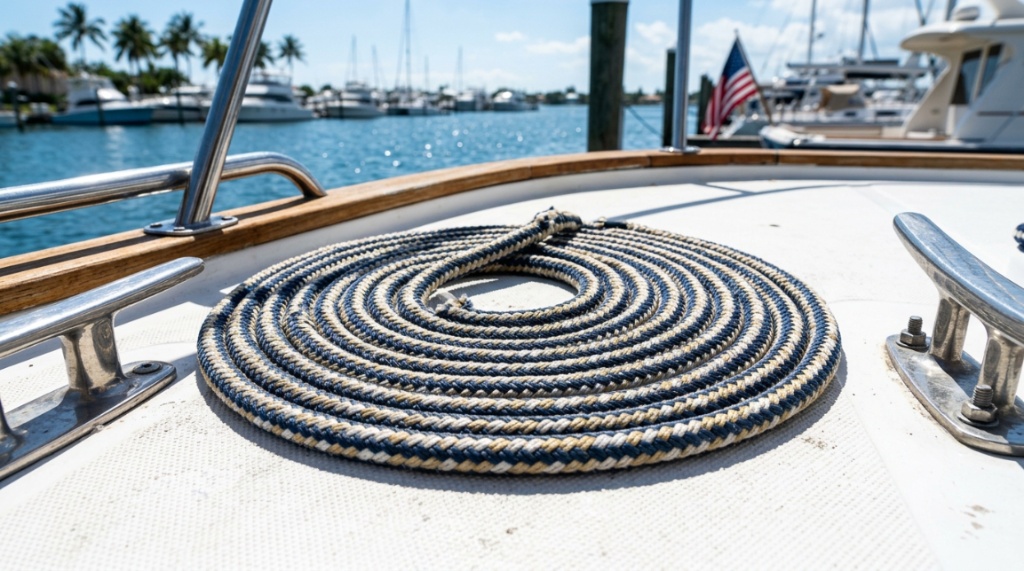
Coiling a rope improperly creates twists that turn into knots and can stress the fibers. Use the traditional “figure-eight” coil method over your hand and elbow. This method preserves the natural lay of the rope and prevents hard twists. When hanging, use a hook that supports the coil evenly to prevent compression damage on the bottom loops.
Storing Lines for Hurricane Season
When a storm approaches, do not leave your expensive dock lines exposed to the elements. Bring them inside, wash them, dry them, and store them in a cool, dark place. If you use extra lines for tying down, keep a dedicated “storm set” that you take out only for the storm and put away afterward, reducing UV exposure and dryness.
What Is the Difference Between Anchor Rode and Dock Lines?
Anchor rode and dock lines are designed for opposite stresses. Dock lines must stretch to absorb the shock of wind and waves. Anchor rode should have minimal stretch so you can feel the anchor set and maintain a low angle to the seabed. Using the wrong one for the job is a common rookie mistake in FL, which has varying bottom types like sand, mud, and coral.
Many FL boaters use a “combination” rode, typically a few feet of chain connected to a synthetic rope. This combo works well, but you must understand the different requirements for each section.
Rode Requirements for Holding Power
For anchor rope, you need a low-stretch material like polyester, which is also called Dacron. This ensures that when your anchor digs in, the pull is direct and hard, rather than having the rope stretch like a bungee, which can dislodge the anchor. The chain part of the rode adds weight, which helps keep the pull angle horizontal to the bottom, improving the anchor’s hold.
Dock Line Requirements for Energy Absorption
Dock lines, by contrast, should be nylone due to its elasticity. If you use a low-stretch polyester for dock lines, the energy from a wake will slam directly into your cleats, potentially cracking fiberglass. Nylon’s stretch absorbs that kinetic energy gradually, reducing stress on the entire boat system.
How to Combine Chain and Rope Correctly
A good rule is to use at least 10 to 20 feet of chain, depending on your boat size. The chain lays on the bottom, providing weight and abrasion resistance, while the rope is used for the majority of the scope length. When you connect them, use a proper galvanized thimble and splice to prevent chafe, not just a shackle tied to an eye splice.
Are There Specific Rope Brands Known for Florida Durability?
Shopping by brand can be easier, but you need to look at their construction details, not just the name. Some brands use premium yacht-grade fibers, while others use basic industrial fibers. Check if they specifically market “UV-stabilized” fibers or “marine grade,” as these have undergone increased testing for sun exposure.
It is also beneficial to buy from a marine supplier that sells a lot of rope in the southeast, as they know what holds up. The brand is less important than the specific material, weave, and treatment. Always read independent reviews from sailors who dock in FL conditions, as they share real-world wear that marketing materials often miss.
Evaluating Weave and Construction Quality
Look at the braid angle—how tightly the strands are woven. A tight, smooth braid tends to hold out sand and is more comfortable to handle. A loose braid may feel soft, but it will wear out quicker. Double-braided polyester is currently a benchmark for dock lines because it has a protective outer jacket and a separate inner core, providing strength and durability.
The Advantages of High-Visibility Lines
In Florida’s often-glaring sun, a high-visibility line (bright yellow or orange) is a safety feature. It prevents trip hazards on the dock and makes it easier to see if a line is about to chafe through. It also makes it easier to spot buoy lines at a distance, reducing the risk of misidentification in busy channels.
Price Point vs. Long-Term Cost Savings
A cheap $10 polypropylene line will need replacement every few months in South Florida. A high-quality $50 polyester double-braid can last three years or more. Over a five-year period, buying cheap is actually more expensive and way more inconvenient. Consider your purchase as an investment in safety and peace of mind.
How Do You Determine the Right Rope for High-Traffic Marinas?
In crowded FL marinas, your lines are subject to rubbing against other boats, metal cleats, and concrete pilings. The physical slapping of lines against masts and rigging also creates noise and wear. In this environment, you need maximum abrasion resistance above all else.
Think about the hard corners and sharp edges. A double-braided line with a soft, yet tough, outer cover works best here to protect the core from cuts. Avoid cheap three-strand twisted ropes that can snag on the rough surfaces of concrete pilings and become fuzzy quickly.
Cleat Size and Tie-Up Techniques
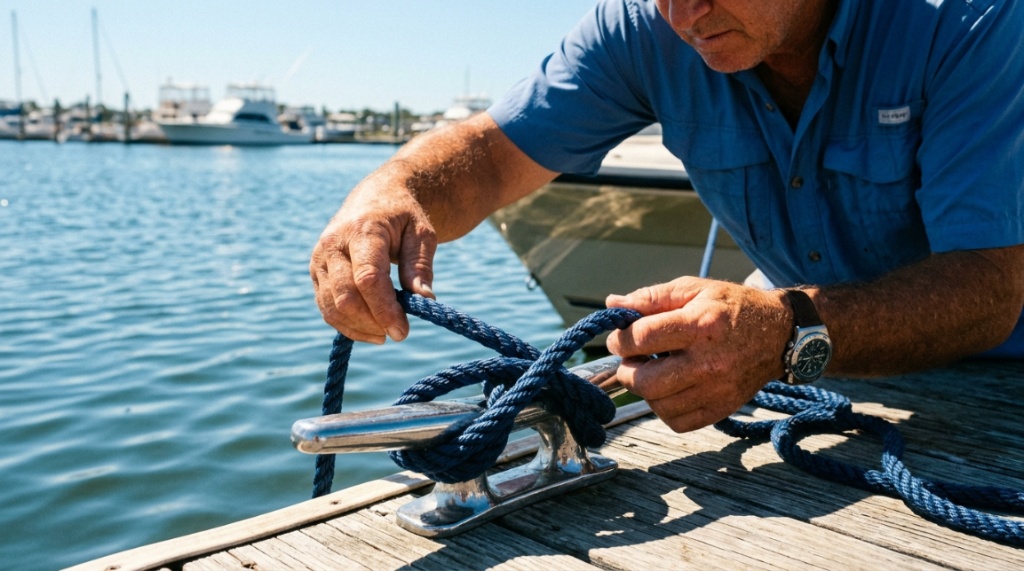
Using a proper cleat hitch reduces wear. Ensure the rope is not pulled over a sharp edge. Use a piece of old fire hose or a plastic spiral wrap over the line at the point of contact with the sheer edge of the dock. This prevents wear on the rope itself and reduces noise.
The Benefit of Snubbers and Shock Absorbers
In high-traffic areas with constant wakes, adding rubber snubbers to your dock lines provides extra shock absorption. This is especially helpful with low-stretch polyester lines. Snubbers are cheap, easy to install, and protect both your rope and the boat’s cleats from sudden jolts.
Frequently Asked Questions
Is polyester or nylon better for Florida dock lines?
For dock lines, nylon is better due to its stretch. It absorbs shock from waves and wakes. Polyester is better for anchor lines because it stretches less, allowing better anchor setting. In FL, use nylon for docking and polyester for anchoring.
How often should I replace my dock lines in Florida?
In Florida’s high-UV environment, inspect your lines every two months. Even with good care, plan to replace them every 2–3 years. If you notice stiffness, fuzziness, or a hard feeling, replace them immediately, regardless of age.
Can I use regular hardware store rope for my boat?
No. Hardware store rope is typically polypropylene or manila, which is not UV resistant or structurally safe for marine use. These ropes can fail suddenly and cause severe damage to your boat and others. Always invest in certified marine-grade ropes.
What is the best rope for a boat lift in saltwater?
For boat lifts, you need a low-stretch, UV-resistant rope. Polyester is an excellent choice, but you should consider solid HDPE (like Dyneema) for maximum strength without water absorption. Avoid nylon for lift cables as its stretch can cause the boat to bounce while lifting.
Do I need separate ropes for hurricane season?
Yes, it is wise to have a set of heavy-duty, longer, and stronger lines specifically for hurricane season. These should be used only during storms and stored in a cool, dry place off-season to maintain their integrity. You can also add chafe guards and use larger diameters.
How do I stop my dock lines from chafing on the dock?
Use chafe guards—either commercial neoprene sleeves or DIY sections of garden hose. Slide them over the rope where it contacts the dock edge or piling. This adds a wear layer and significantly extends the rope’s life.
Conclusion: Secure Your Peace of Mind on the Water
Comparing marine ropes goes far beyond picking the thickest one. It is about choosing the right material for the specific stress—whether that is the shock absorption of nylon for dock lines or the low stretch of polyester for anchors. In Florida’s demanding environment, prioritizing UV resistance, abrasion protection, and proper maintenance is non-negotiable. You now have the knowledge to evaluate your own setup, make informed purchases, and inspect your lines for hidden damage. Do not wait for a storm to test your gear. Start by checking your current ropes today. If they show any signs of stiffness or heavy fuzz, replace them with a trusted, marine-grade option, and remember to add chafe guards for extra protection. Your boat, your wallet, and your dock neighbors will thank you.

You May Like
How to Improve Back Comfort with Your Office Chair in WA