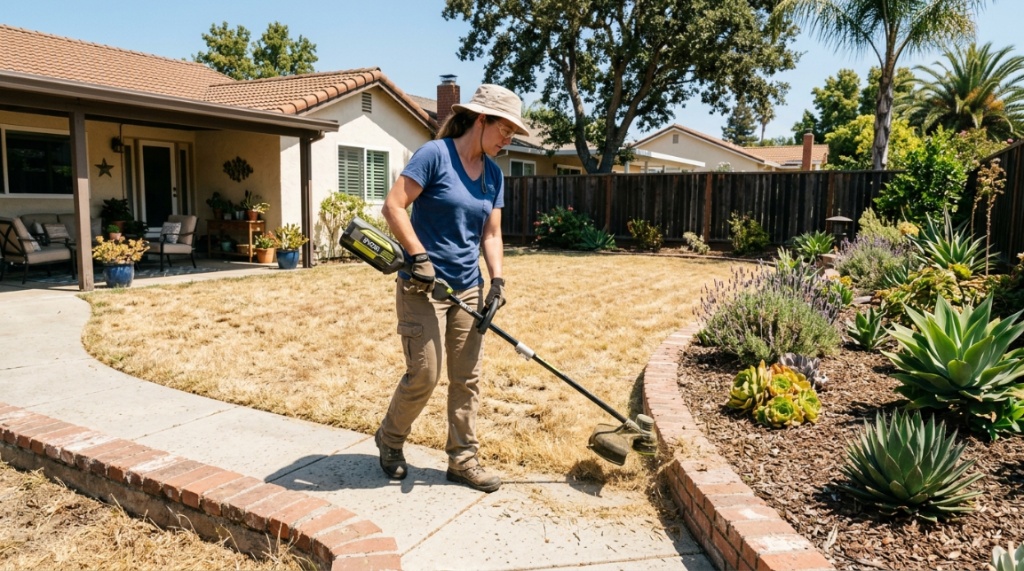
California landscaping comes with its own set of challenges. Whether you are dealing with the dry, brittle brush of the inland valleys, the dense, fast-growing grasses along the coast, or the rocky terrain of the foothills, your equipment needs to be versatile and reliable. If you are tired of dealing with gas fumes, tangled cords, and finicky pull-starts, you are probably already considering a battery-powered model. However, choosing the right one goes beyond just picking the most popular brand at the hardware store. You need a machine that matches your yard size, handles the specific vegetation you are fighting, and fits within local regulations. This guide walks you through everything you need to know to choose the best cordless string trimmer for california yards, ensuring you get the job done efficiently without the environmental guilt.
Key Takeaways
- Battery voltage and amp-hours matter more than brand name; they determine whether your trimmer can actually power through thick California weeds without dying mid-yard.
- Payload weight and balance are critical; holding a 12-pound trimmer at odd angles on a hillside is exhausting, so look for brushless motors and ergonomic grips.
- String feed systems (bump vs. auto-feed) significantly impact your workflow; bump feeds are more reliable for thick brush, while auto-feed saves time on simple grass.
- California’s dry climate means you need a trimmer that can handle dry dirt and debris without clogging, and you should prioritize models with easy-to-clean air intakes.
- Consider the 80-volt class for large properties (over half an acre) or stick to 40-volt for smaller urban lots to save money and weight.
Why Cordless Makes Sense for California Homes
The shift to battery-powered outdoor equipment is more than just a trend; it is a practical response to the realities of California living. The state has some of the strictest emissions regulations in the country, and many local municipalities are actively encouraging, or even mandating, a switch away from gas-powered leaf blowers and trimmers. Cordless models eliminate the need for mixing fuel, storing gasoline, and dealing with the associated fumes. For the average homeowner, they are simply more convenient to grab and go. You do not have to worry about a cord getting wrapped around a rose bush, and you can easily maneuver around water features or garden beds without a safety hazard.
On a purely practical level, modern lithium-ion batteries have closed the performance gap with gas engines. A high-voltage brushless trimmer can spin the line fast enough to cut through wild grass and light brush, which is often all that is required for a residential property. The immediate torque provided by an electric motor also means you do not have to rev the engine to get maximum cutting power; the machine responds instantly to the trigger. This makes the trimming process smoother, quieter, and less fatiguing, especially if you are maintaining a large perimeter around your home.
Matching Voltage and Power to Your Yard Size
Before you look at the cutting width or the type of line, you must determine the power class you need. This is primarily dictated by the size of your property and the density of the growth you need to cut.
The 40-Volt Standard for Urban and Suburban Lots
For most standard suburban California lots—think quarter-acre to half-acre—a 40-volt trimmer is the sweet spot. These machines are lightweight, usually weighing between 8 and 10 pounds, and they are nimble enough to get into tight corners. They are perfect for edging along driveways, trimming around planter boxes, and maintaining Bermuda grass or fescue. If your yard is relatively flat and you trim for 20 to 30 minutes at a time, a 40-volt brushless model will serve you well. The trade-off is power; if you bog the head down into heavy, wet, or thick growth, the motor may stall or require you to slow down your swing speed.
The 80-Volt Class for Acreage and Hillsides
If you live in the hills of Los Angeles, the valleys of San Diego, or anywhere with a large slope or a lot of native vegetation, you need the 80-volt class (or equivalent high-power 60-volt systems). These trimmers are heavier, but they offer the torque necessary to slice through sumac, wild blackberry canes, and tough, woody weeds that pop up near the fence line. They are also better suited for areas with heavy adobe soil, where the trimmer head constantly kicks up dirt and rocks. The higher voltage also means longer runtime at the same cutting power. If you have a big, rugged yard, buying an 80-volt trimmer will save you from the frustration of a machine that simply doesn’t have enough guts to finish the job.
Key Features to Evaluate Before Purchase
Once you have settled on a voltage class, you need to look at the specific features that affect usability and durability. California yards are notoriously tough on equipment due to the dry, dusty conditions and the hard, compacted soil, To prepare your landscape before tackling overgrown edges, read our guide on Successfully Re-Designing your Garden.
Battery Capacity (Ah) Over Peak Power
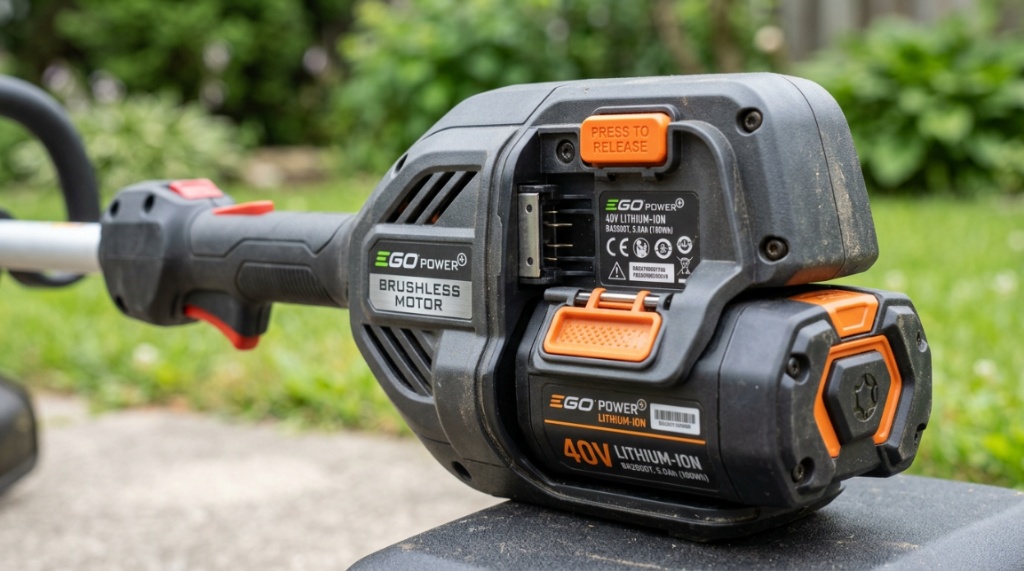
Do not get distracted by “peak power” marketing. Look at the Amp-hours (Ah) of the battery. A 2.5Ah battery will run roughly half as long as a 5Ah battery under the same load. If you are purchasing a trimmer that uses the same battery platform as a leaf blower or chainsaw, buy a “tool only” version and invest in a larger battery or a second battery. Running a trimmer on low battery in thick grass is a recipe for overheating and a shorter battery lifespan. Plan for your battery to last about 30–45 minutes under continuous load; anything less usually requires a second battery to complete a full yard.
Brushless vs. Brushed Motors
You should strongly prefer a brushless motor. They are more expensive, but they are significantly more efficient and durable. Brushed motors generate heat and friction, which wears down the carbon brushes over time. In a dusty California environment, that dirt can accelerate wear. Brushless motors are sealed more effectively and they provide more torque at lower speeds. They also run cooler, which is critical when you are trimming during the late morning heat. A brushless model will last years longer than a brushed equivalent used in the same harsh conditions.
Line Feed Systems and Cutting Width
The headache of manually bumping the head to release new line is a reality for many. You have two main choices here: bump feed and automatic feed.
- Bump Feed: This is the most common and reliable method. You tap the bottom of the trimmer head on the ground, and it releases a small amount of line. This works well but requires a rhythm and can be annoying if you are reaching under a low hedge.
- Auto Feed: This system automatically pushes out new line when the RPM drops during use. It is excellent for simple grass but can sometimes feed too much line, causing the trimmer to bog down or the line to break prematurely.
For cutting width, look for 15 to 17 inches. A wider cutting swath means you cover more ground faster, but it also increases the load on the motor and battery. On a steep hill, a wide head is harder to control. A 16-inch head is a good compromise for most users.
The Importance of Ergonomics and Weight Distribution
Trimming is a repetitive, awkward task. You are constantly twisting your torso and holding the tool at odd angles. The weight of the trimmer, and where that weight sits, makes a massive difference in your fatigue level.
Most of the weight in a cordless trimmer is in the battery, which is usually mounted at the rear. This design actually creates a counterbalance to the heavy cutting head at the front. However, if the trimmer is poorly balanced, you will feel constant strain in your wrists and shoulders. Look for a model with adjustable auxiliary handles. A good auxiliary handle allows you to change your grip position, which helps you use the tool on slopes without having to bend your back unnecessarily. The shaft length is also critical; the trimmer head should sit just above the ground without you having to hunch your shoulders. If you are tall (over 6 feet), look for a two-piece shaft that extends to meet your height.
Durability and Maintenance for Dry, Dusty Conditions
California’s dry summers create a specific problem for trimmers: dust and dry grass particles. These particles can get sucked into the motor housing and clog the air vents, causing the tool to overheat and shut down. When comparing models, look at the airflow design. Some trimmers have clog-resistant vents or a “high airflow” channel that keeps debris away from the internals.
You should also consider the shaft. A solid steel or aluminum shaft is much more durable than a plastic one. If you are trimming along a gravel pathway or near a rocky border, rocks will bounce up and strike the shaft. A fiberglass or heavy-duty composite shaft is fine for light use, but if you are a ‘weekend warrior’ who is aggressive with the throttle, metal is the safer investment. Another overlooked point is the drive shaft. Many trimmers use a flexible cable inside the shaft. These require occasional greasing, but they are less prone to breaking. If you hear a rattling sound inside the shaft, stop using it immediately; a broken drive shaft is a costly repair.
Adapting to California Terrain: Tools and Techniques
The “California yard” is rarely uniform. You might have a flat front lawn, a steep side slope, and a dry creek bed at the back. Your trimmer needs to adapt to these zones.
Hillside and Slope Management
On slopes, gravity is working against you. The weight of the trimmer can drag you forward, and the rotation of the line can pull you off balance. For heavy slope work, consider a harness or a shoulder strap. This transfers the weight of the machine from your arms to your torso. It is a simple accessory that pays for itself in reduced fatigue. When cutting on a slope, do not sweep the trimmer in a wide arc. Instead, use short, controlled motions moving across the slope (horizontally) to avoid cutting into the soil.
Edging: Rotating the Head
The ability to rotate the trimmer head 180 degrees is essential for edging along driveways and sidewalks. Some trimmers require a tool to loosen a bolt; better models have a quick-release lever. This feature is not just a convenience; it is necessary to keep your turf manicured. When edging, use the guard as a guide against the concrete. Keep the line perpendicular to the ground and let the wheel (on edging models) or the guard do the work. Do not force the trimmer; let the weight of the head do the cutting.
Frequently Asked Questions
Can I use a cordless trimmer on thick weeds and blackberry bushes?
Yes, but only if you choose a high-voltage model (80V or high-torque 60V) and use a heavy-duty string line, such as a .095” or .105” twisted line. Lower-voltage models will struggle and may stall in dense growth.
How long does the battery actually last on a string trimmer?
Most batteries last 20 to 45 minutes under continuous load. However, this depends on the Ah rating of the battery and the thickness of the grass. If you are trimming wet, thick grass, expect the runtime to be closer to the 20-minute mark. If you are just tidying up dry edges, it will last longer.
Is it better to buy a trimmer that uses the same battery as my other tools?
Yes, this is smart for most homeowners. Buying a “tool-only” trimmer and using batteries from your leaf blower or chainsaw saves a significant amount of money and reduces the number of chargers cluttering your garage. Just verify the voltage matches.
What is the best cutting line for a cordless trimmer?
For most California residential yards, a .080” or .095” round line is sufficient for grass. If you have weeds or dry brush, switch to a .105” twisted or star-shaped line. It cuts better but requires more power.
Why does my cordless trimmer stop when it is hot outside?
This is a safety feature. The battery management system (BMS) reduces power or shuts down the tool if the motor or battery gets too hot. This is common in temperatures above 95°F. Let the tool cool down in the shade for 15–20 minutes before resuming.
Conclusion
Choosing the right cordless string trimmer for your California yard comes down to matching power to your property size and prioritizing ergonomics that suit your body. Remember that battery technology is the driving factor in this decision; look for brushless motors and high amp-hour batteries for the best reliability. Don’t be afraid to invest in the 80-volt class if you have a large or steep property, as the extra power will save you time and frustration. A cordless trimmer is a long-term purchase that makes yard maintenance faster, quieter, and more pleasant. Once you have selected the right model, maintain the battery properly, keep the vents clean, and you will have a reliable tool that handles the unique challenges of the California landscape for years to come.

You May Like