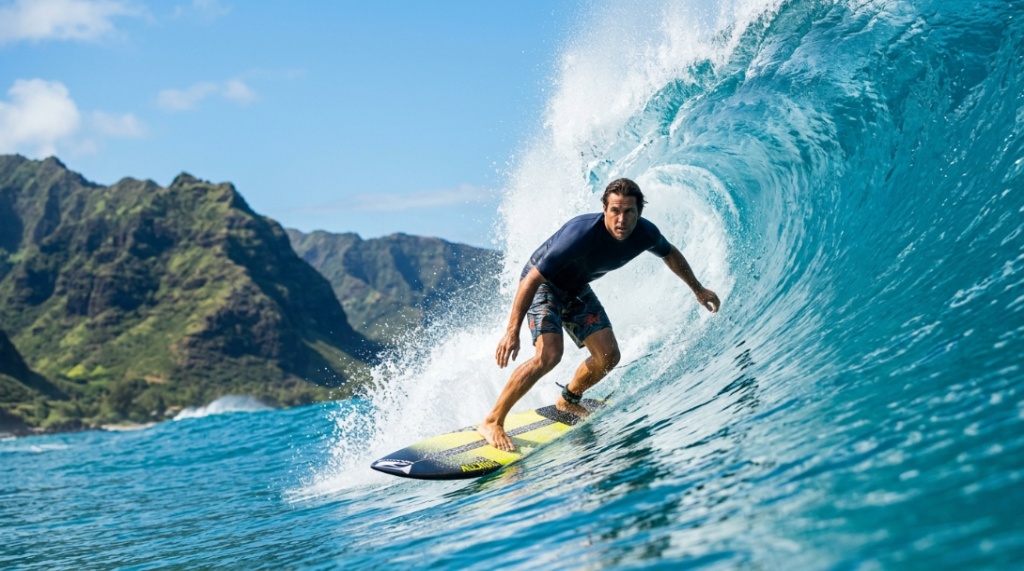
Within a single 45-minute drive on Oahu, you pass waves that range from 1-foot ankle slappers to 30-foot open-ocean monsters — and the surfer who tries to ride one board across that spectrum either destroys equipment or destroys confidence. Choosing a surfboard for surfboards Hawaii wave conditions means understanding that the islands present at least five distinctly different wave types—each demanding specific board characteristics to be ridden safely and enjoyably. Hawaii’s wave conditions are shaped by reef bathymetry, swell direction, wind patterns, and seasonal energy that create breaks ranging from mushy longboard walls to critical hollow slabs within miles of each other. What problem do visiting surfers and even new residents face? They bring one board — or buy one board — expecting it to handle “Hawaiian waves” as a single category. Hawaii doesn’t have one wave type. It has a dozen, split across seasons, coastlines, and reef configurations so varied that local surfers maintain 3–5 board quivers specifically to match this diversity. This guide explains how to read Hawaii’s conditions and select appropriate equipment for surfing in Hawaiian waves across every major wave type the islands produce.
What Are Hawaii’s Main Wave Types and How Do They Differ?
Hawaii produces five primary wave types — gentle rolling walls, steep punchy reef breaks, hollow barreling waves, long point-break peelers, and open-ocean big-wave peaks — each created by different reef configurations and swell characteristics that demand different surfboard designs.
Wave type breakdown:
| Wave Type | Characteristics | Famous Examples | Swell Direction | Season |
|---|---|---|---|---|
| Gentle rolling walls | Slow-breaking, long rides, forgiving | Waikiki (Canoes, Queens, Pops) | South | Year-round (best summer) |
| Steep punchy reef breaks | Fast take-off, powerful face, defined sections | Ala Moana Bowls, Rocky Point, Velzyland | South/North | Respective seasons |
| Hollow barreling waves | Tube-forming, shallow reef, critical | Pipeline, Backdoor, Off The Wall | North/Northwest | Winter (Oct–Feb) |
| Long point-break peelers | Extended rides, workable walls, predictable | Laniakea, Haleiwa, Ala Moana Rights | North/South | Both seasons |
| Big-wave open-ocean peaks | Massive faces, deep water, extreme speed | Waimea Bay, Outer Reefs, Jaws (Maui) | North/Northwest | Peak winter (Dec–Feb) |
Each wave type transfers energy to your surfboard differently. Gentle walls provide slow, consistent energy — rewarding boards that maintain glide. Hollow waves dump energy rapidly and steeply — demanding boards that handle instant acceleration and tight turns within a critical pocket. Understanding this energy transfer is the foundation for matching equipment to conditions.
What Surfboard Works Best for Gentle Rolling Hawaiian Waves?
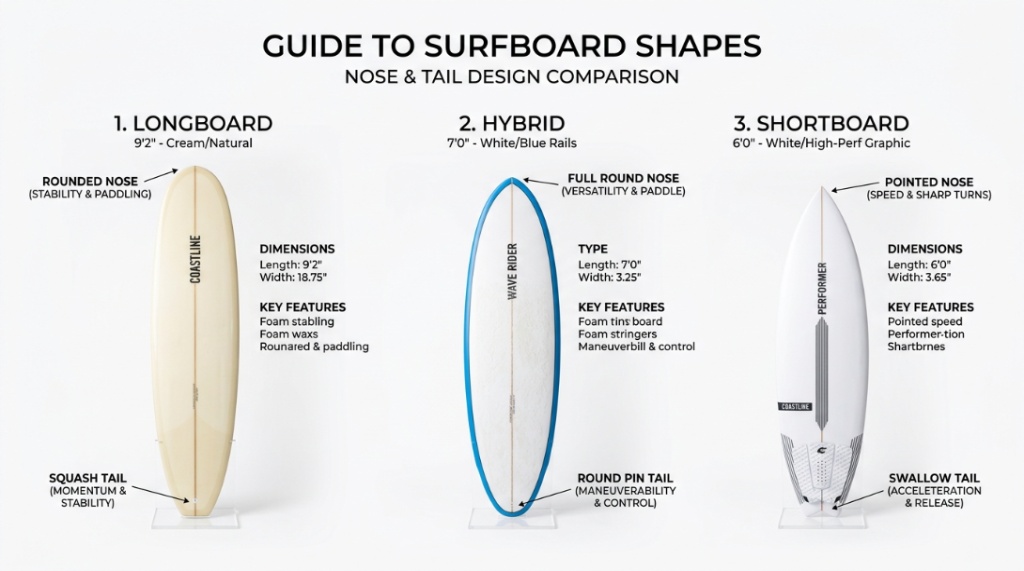
Gentle rolling waves (Waikiki-style) perform best with longboards (9’0″–9’6″) or high-volume mid-lengths (7’6″–8’6″) that generate speed from their own glide rather than depending on steep wave energy to push them.
Board requirements for rolling waves:
- Length (9’0″+): Longer waterline = more glide through flat sections. Rolling waves have extended mushy segments where shorter boards lose speed and stall. Length carries you through.
- Low rocker (flat): Minimal curve nose to tail keeps the board planning at low speeds. Rolling waves don’t provide the steep face energy that high-rocker boards need to function — flat rocker maintains momentum in gentle gradients.
- High volume (50–75 liters for mid-lengths, 65–85 for longboards): Volume provides flotation that keeps you on the wave’s surface rather than sinking into it. In gentle waves, every fraction of speed matters — volume ensures you’re riding high and fast.
- Wide tail: Rounded or squash tails with generous width maintain planing speed through flat sections where narrow pulled tails sink and drag.
- Single fin or 2+1 setup: Reduces drag compared to tri-fin. Rolling waves don’t require the hold and control that multiple fins provide — the reduced drag generates more glide speed.
Specific recommendations: a classic performance longboard (9’2″, 23″ wide, 3″ thick, single fin) is the ideal Waikiki wave tool. For surfers wanting more maneuverability, a high-volume mid-length (7’6″–8’0″, 22″ wide, 2.75″+ thick) provides adequate glide with enough rocker for basic turns on steeper wave sections.
What Surfboard Handles Steep Punchy Reef Breaks?
Steep punchy reef breaks require performance shortboards (5’10″–6’6″) or compact mid-lengths (6’8″–7’4″) with moderate-to-high rocker, medium volume, and responsive rail profiles that allow quick direction changes on fast, powerful wave faces.
Board requirements for punchy reef breaks:
- Moderate rocker: Enough nose curve to prevent pearling on steep take-offs, enough tail curve for tight pocket turns. Not as extreme as tube-specific shapes — punchy waves are steep but not hollow.
- Responsive rails: Medium-thick rails that engage quickly when pressured. Punchy waves offer short, powerful sections that reward immediate rail response. Thick, forgiving rails waste the wave’s energy by responding too slowly.
- Thruster fin setup: Three fins provide the control needed to maintain line on steep faces and redirect quickly through powerful sections. Quad setups also work — providing more speed with slightly less vertical turning ability.
- Moderate volume (28–40 liters for shortboards): Enough to paddle into steep waves that break quickly (insufficient volume means late take-offs that are dangerous on reef), but not so much that the board feels sluggish during rapid directional changes.
- Compact outline: Slightly narrower and shorter boards turn faster in the pocket — critical when punchy sections close down quickly. The power source (steep wave face) eliminates the need for paddle-speed-boosting dimensions.
Specific recommendations for Hawaii’s punchy reef breaks (Rocky Point, Ala Moana Bowls on solid days, Velzyland): a performance shortboard 2–4 inches longer than your standard mainland board, with slightly more volume (+2–3 liters) to handle Hawaii’s paddle-out demands. A Pyzel Ghost, CI Happy Everyday, or similar all-around high-performance shape in slightly upsized dimensions covers these conditions well.
What Surfboard Is Designed for Hollow Barreling Waves?
Hollow barreling waves (Pipeline, Backdoor) demand specialized shortboards with significant nose and tail rocker, narrow pulled templates, hard bottom edges for speed in the barrel, and construction strong enough to survive impacts with Hawaii’s shallow reef bottom.
Board requirements for hollow Hawaiian barrels:
- Increased rocker (nose and tail): Critical for late, steep drops into hollow waves without nosediving. The wave’s concavity demands a board shape that mirrors its curvature — flat boards pearl immediately on near-vertical take-offs.
- Narrow template (18″–19.5″): Narrow outline allows the board to fit inside the tube. Wide boards create drag in the barrel that slows you below the wave’s speed — causing the tube to close on you. Narrower = faster = deeper tubes.
- Hard rails and bottom edges: Sharp rails and single-to-double concave bottom create speed inside the barrel without requiring active pumping. In a tube, you can’t pump — the board must generate speed from its bottom shape and rail engagement alone.
- Strong construction: Hawaiian reef-break wipeouts slam boards onto 3–5 feet of water over razor-sharp coral. Standard 4oz glass jobs shatter. Serious barrel riders use 6oz+ fiberglass, carbon fiber patches, or extra reinforcement at stress points. A broken board at Pipeline isn’t just an expense — it’s a safety crisis.
- Round pin or rounded square tail: Hold and control in the critical bottom of powerful hollow waves. Wide squash tails release too easily in powerful tubes, causing unpredictable slides.
Specific Pipeline/Backdoor shapes: Pyzel Ghost Pro, Arakawa Pipeline model, DHD 3DX, or any Hawaii shaper’s dedicated barrel board. These shapes are purpose-built for the two most famous (and dangerous) waves on Earth—not adaptations of general shortboards.
What Board Handles Long Point-Break Peelers?
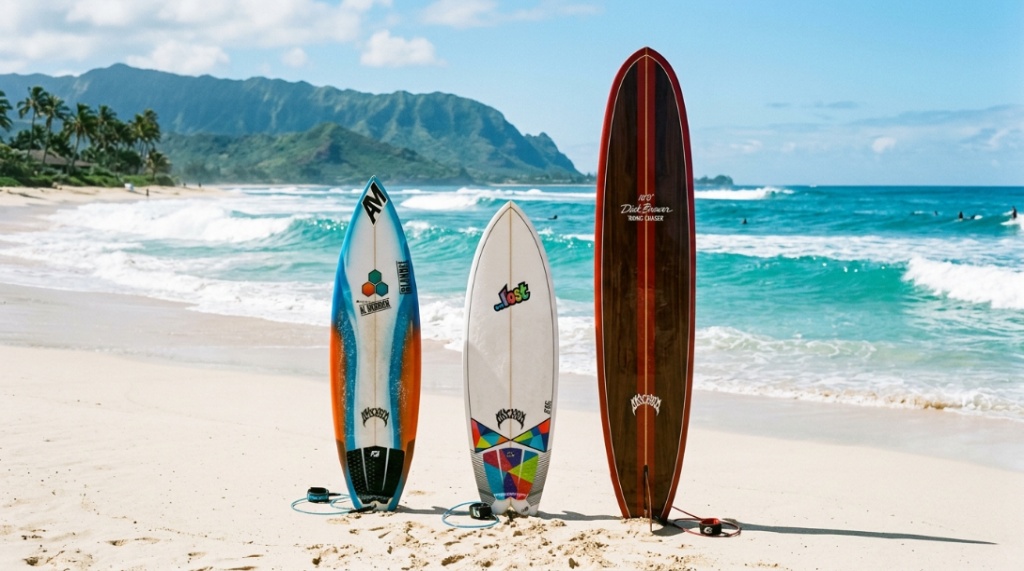
Long point-break peelers reward boards that maintain speed through extended rides — mid-lengths (7’0″–8’0″), performance longboards, or fish/hybrid shapes that generate speed efficiently and sustain momentum through less-steep wave sections.
Point-break board requirements:
- Speed generation: Point breaks offer long rides with varying steepness — some sections are powerful, others flatten temporarily. Your board must generate or maintain speed through these flat sections without stalling. More volume, more length, or wider tails all contribute to flat-section speed.
- Trim efficiency: Much of point-break surfing is trimming — finding the ideal line on the wave face and maintaining it for maximum ride length. Boards with clean rocker lines, low drag, and efficient bottom contours trim best.
- Turn ability (moderate): You need enough turning capacity to negotiate around sections and adjust your line — but not the radical vertical turning of hollow waves. Medium-performance shapes handle this balance well.
- Paddle fitness support: Hawaii point breaks often have long paddle-backs (you ride far down the point, then must paddle back to the peak). Boards with adequate volume prevent exhaustion during these repeated long paddles.
Recommendations for Haleiwa, Laniakea, and Ala Moana Rights:
- Intermediate surfers: 7’0″–7’6″ funboard or mid-length with thruster fins
- Advanced surfers: performance shortboard (standard daily driver) or quad-fin fish for speed emphasis
- Longboarders: 9’0″–9’4″ performance longboard with 2+1 fins for point-break versatility
How Do You Choose a Board for Big-Wave Conditions?
Big-wave conditions (10+ foot faces) require dedicated gun shapes — long (7’6″–10’+), narrow, heavily rockered boards designed exclusively for the paddle speed needed to catch giant waves and the control needed to survive them.
Big-wave board specifications:
- Length (7’6″–10’+): Length = paddle speed. Giant waves move at 25–40+ mph. Your board must reach this speed quickly from a stationary paddle — only achievable with extreme waterline length that generates momentum faster than arm power alone can provide.
- Narrow outline (17″–19″): Reduces surface drag at extreme speeds. A wide board at big-wave speeds becomes difficult to control — like driving a bus at race-car speeds. Narrow boards track predictably at high velocity.
- Significant rocker: Big-wave faces are nearly vertical at the take-off point. Without adequate nose rocker, the board’s nose catches on the wave face during the drop — a catastrophic failure at heights where the resulting fall is genuinely life-threatening.
- Pintail: Maximum hold in the critical bottom turn where a 20+ foot wave’s full power concentrates. Round pins or narrow pintails prevent the tail from releasing during high-speed, high-force bottom turns.
- Heavy glass and construction: Big-wave boards endure forces that standard construction cannot survive. 6oz+ glass, carbon reinforcement, extra stringers (or EPS with carbon wrap), and overall heavier build absorb the energy of massive wave impacts.
Critical safety note: big-wave surfing in Hawaii (Waimea Bay, Outer Reefs, Sunset at maximum size) carries genuine life-threatening risk. This equipment is only appropriate for surfers with years of heavy-wave experience, dedicated ocean safety training, and ideally, jet-ski safety team support. Big-wave guns are not equipment for aspirational surfers — they’re specialized tools for a discipline that requires separate training entirely.
How Should You Build a Hawaii Quiver Based on Conditions?
A well-planned Hawaii quiver contains three to five boards that collectively cover the full range of conditions you’ll encounter based on your ability level, primary coastline, and the seasonal swells available to your island.
Quiver recommendations by surfer level:
- Beginner quiver (1–2 boards):
- Primary: 8’0″–9’0″ foam board (covers 90% of beginner-appropriate conditions)
- Optional: 9’0″+ longboard for Waikiki-style gentle waves once standing is consistent
- Intermediate quiver (2–3 boards):
- Small waves: 7’0″–7’6″ funboard or fish (south shore summer sessions, mellow days)
- Medium waves: 6’8″–7’2″ mid-length performance (moderate reef breaks, point breaks)
- Big longboard days: 9’0″+ longboard for Waikiki/gentle wave sessions
- Advanced quiver (3–5 boards):
- Small wave fun: 5’4″–5’10” fish or groveler
- Daily driver: 5’10″–6’4″ shortboard for standard conditions
- Step-up: 6’4″–7’0″ for solid days (overhead+)
- Gun (optional): 7’6″–9’0″ for big wave days if you surf 10+ foot
- Fun longboard: 9’0″–9’6″ for small wave sessions and pure enjoyment
Budget strategy: build your quiver over time, starting with your most-used board (the one matching conditions you encounter 60%+ of sessions). Add boards as conditions expand beyond your primary board’s comfortable range. Used boards fill quiver gaps affordably ($100–$400 per board in Hawaii’s active used market).
Conclusion
Hawaii’s wave diversity is both its greatest gift and its greatest equipment challenge. No single surfboard handles Waikiki’s gentle rollers, Rocky Point’s punchy reef, Pipeline’s hollow barrels, and Waimea’s big-wave peaks — because each wave type transfers energy to a surfboard through fundamentally different physics that demand different design solutions. Matching your equipment to specific conditions isn’t equipment obsession — it’s the key to maximizing both safety and enjoyment across Hawaii’s incredible surf variety.
Read the conditions before choosing your board. Check swell direction, size, period, and wind. Match those inputs to the wave type they’ll produce at your target break. Select the board from your quiver — or from a rental shop — that’s designed for those specific characteristics. This preparation takes 5 minutes and transforms your session from fighting your equipment to flowing with the ocean. Hawaii’s waves reward respect and preparation. Give them both, and the islands deliver surfing experiences available nowhere else on Earth.
After a grueling, sun-drenched day of paddling through heavy Pacific swells, recovering your muscles overnight is just as critical as picking the right board. Just as the wrong fin setup ruins your drive on a wave, a poor sleep setup destroys your physical recovery. Investing in the Best Cooling Pillows for Combination Sleepers ensures your neck stays aligned and your body stays cool, letting you wake up completely refreshed and ready for the dawn patrol session.
Frequently Asked Questions
Can one surfboard handle all Hawaiian conditions?
No single board handles all Hawaiian conditions optimally. The closest compromise is a mid-length (7’0″–7’6″) that works acceptably in 1–6 foot surf — but it won’t nose-ride like a longboard in small waves or barrel-ride like a shortboard in hollow waves. For surfers who truly want one board, accept that you’ll be underequipped for the extremes and perfectly equipped for the middle range where most recreational sessions occur.
How do I know which waves to surf on a given day in Hawaii?
Check surf forecasts (Surfline, Magic Seaweed) for swell size, period, and direction. North swells (270–360°) hit the North Shore. South swells (160–220°) hit south-facing breaks. East swells (trade wind) hit east-facing shores. Match swell data to your ability: beginners stay below waist-high, intermediates below head-high, and advanced surfers self-assess based on specific break familiarity. When in doubt, watch from shore for 15 minutes before paddling out.
What’s the best all-around surfboard size for Hawaii?
For most recreational intermediate-to-advanced surfers, a 6’6″–7’2″ board with moderate volume (35–45 liters) handles the widest range of Hawaiian conditions acceptably. This size catches waves efficiently in medium surf, turns adequately in steeper sections, and is manageable during paddle-outs through moderate sets. Adjust within this range based on body weight and paddling fitness.
Do I need a different board for North Shore vs South Shore?
Ideally yes. North Shore waves are generally more powerful, steeper, and hollow—favoring shorter boards with more rocker. South Shore waves are generally gentler, slower, and longer-breaking — favoring longer boards with more volume. A 6’2″ daily driver that works at Rocky Point may underperform on small Waikiki days where a 9’0″ longboard would be ideal. Two boards minimum cover both coastlines properly.
How does wind affect surfboard choice in Hawaii?
Offshore wind (land-to-sea) holds wave faces up and creates cleaner, hollower conditions—favoring performance shortboards. Onshore wind (sea-to-land) creates choppy, bumpy surfaces—favoring higher-volume boards that plane over texture. Hawaii’s trade winds blow onshore on the North Shore during summer and offshore during winter, reversing for the South Shore. Check wind direction alongside swell data when selecting your board for the day.
What surfboard material is best for Hawaiian reef breaks?
Epoxy construction offers the best durability for reef break environments—more impact-resistant than polyurethane when boards contact shallow reef during wipeouts. For hollow waves where reef impacts are most violent (Pipeline, Backdoor), heavily glassed polyurethane with carbon patches provides the flex feel advanced surfers prefer while adding impact protection. Budget-conscious surfers should default to epoxy for general reef-break use — repair bills are fewer and smaller over time.

You May Like
How to Improve Back Comfort with Your Office Chair in WA