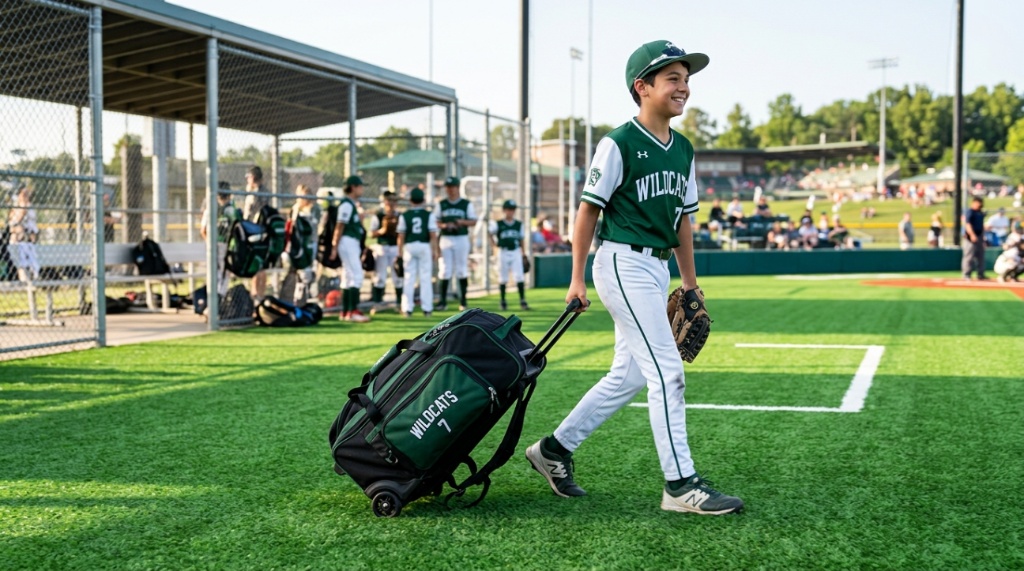
If you’ve ever hauled a 35-pound equipment bag across a sticky parking lot, you know the struggle is real. Your shoulder aches, the strap digs in, and by the time you reach the dugout, you’re already tired. A wheeled baseball bag sounds like the obvious fix, but it’s not always the right choice for every player. The question of whether a wheeled baseball bag worth it depends on your age, how you travel, storage space, and the type of gear you carry. This guide breaks down the real trade-offs so you can make a confident decision without wasting money on the wrong style.
What Exactly Counts as a Wheeled Baseball Bag?
A wheeled baseball bag is essentially a duffel or backpack-style equipment bag mounted on a rigid frame with wheels and a telescoping handle. Unlike standard duffels that you sling over your shoulder, these bags roll upright like luggage. They come in two main configurations: traditional rolling duffels that pull behind you and rolling backpacks that convert from a backpack to a wheeled cart.
The core benefit is obvious—you eliminate the strain of carrying heavy gear on your body. But that benefit comes with added weight, bulk, and mechanical parts that can fail. Understanding these trade-offs is the first step in deciding if this style fits your situation.
Rolling Duffel vs. Rolling Backpack
Rolling duffels are the most common type. They feature a large main compartment, wheels on one end, and a handle that extends from the opposite end. These work best for players who drive directly to the field and don’t need to carry the bag far once they arrive.
Rolling backpacks offer more flexibility. You can wear them on your back for short distances—like walking through a parking garage or up stairs—then switch to wheel mode for longer stretches. This hybrid design solves one of the biggest complaints about rolling duffels: their awkwardness on stairs and uneven terrain.
When a Wheeled Bag Makes Sense
Wheeled bags shine in specific situations. If you recognize yourself in any of these scenarios, a rolling bag could genuinely improve your game-day experience.
You Carry Heavy Gear Regularly
Catchers have the heaviest load by far. Between a chest protector, leg guards, helmet, mask, and multiple gloves, a catcher’s bag can easily exceed 40 pounds. Carrying that on one shoulder day after day leads to muscle imbalances and chronic pain. A wheeled bag distributes that weight to the ground, saving your back and shoulders.
Pitchers also benefit if they carry buckets of balls, weighted training aids, or multiple gloves. If your bag consistently weighs more than 25 pounds, the case for wheels gets stronger.
You Walk Long Distances to the Field
Some facilities require parking far from the fields. Tournament complexes, college campuses, and urban parks often have long walks from the car to the dugout. Rolling your gear beats carrying it every time, especially in summer heat.
However, this only works if the path is smooth. Sidewalks, paved walkways, and flat concourses are ideal. If your typical route involves gravel, grass, or dirt paths, wheels become more of a hindrance than a help.
You Have Back or Shoulder Issues
Players recovering from injuries or dealing with chronic pain should avoid loading their spine asymmetrically. A heavy duffel on one shoulder creates torque through the lower back. Rolling the bag keeps your body in neutral alignment. If a doctor or physical therapist has advised you to limit lifting, a wheeled bag is a practical accommodation.
When a Wheeled Bag Is Not Worth It
Wheeled bags have real downsides that make them a poor fit for certain players. Be honest about your situation before committing.
You Play on Fields Without Paved Access
This is the biggest deal-breaker. Rolling a bag across grass, dirt, or gravel is frustrating. The wheels sink into soft ground, the bag tips over constantly, and you end up carrying it anyway. If your home field requires crossing a grassy field to reach the dugout, a traditional backpack or duffel is more practical.
You Travel by Bus or Train
Team buses often have limited cargo space. Wheeled bags are bulky and don’t compress well. They also take up more room in overhead compartments or under seats. If you regularly travel with a team on charter buses, a soft-sided backpack that can be squished into tight spaces is usually better, If you also need accessories for off-field daily travel, be sure to Select Leather Luxury Tote Bags That Last for Daily Use to keep your everyday items organized and stylish.
You’re a Younger Player with Light Gear
Youth players in T-ball or coach-pitch divisions simply don’t carry enough gear to justify wheels. A small backpack weighing 10 pounds is easy to carry. Adding wheels to that equation only adds unnecessary weight and cost. Most experts recommend waiting until at least middle school age before considering a wheeled bag.
Key Factors to Evaluate Before Buying
If you’ve decided a wheeled bag might work for you, don’t just grab the first one you see. Evaluate these specific factors to ensure you get a bag that lasts and actually functions well.
Wheel Quality and Size
Not all wheels are created equal. Look for wheels that are at least 3 inches in diameter. Smaller wheels get caught on cracks and uneven surfaces. Larger wheels roll more smoothly over transitions like sidewalk joints and curbs.
Check whether the wheels are made of hard plastic or softer rubber. Rubber wheels provide better traction and absorb vibration, but they wear down faster. Hard plastic wheels last longer but can be noisy and skid on smooth floors.
Handle Design and Height
The telescoping handle should extend to a height that allows you to walk upright without bending. A handle that’s too short forces you to hunch, which defeats the purpose of reducing strain. Look for handles with multiple locking positions so you can adjust for your height.
Also check the handle grip. Foam or rubber grips are more comfortable than bare metal, especially on hot days or during long walks.
Frame Construction
The frame is the backbone of a wheeled bag. Aluminum frames are lightweight but can bend under extreme weight. Steel frames are stronger but heavier. For most players, a reinforced plastic or aluminum frame is sufficient. Avoid bags with flimsy frames that flex when you lift them—they won’t survive a full season.
Storage Capacity and Organization
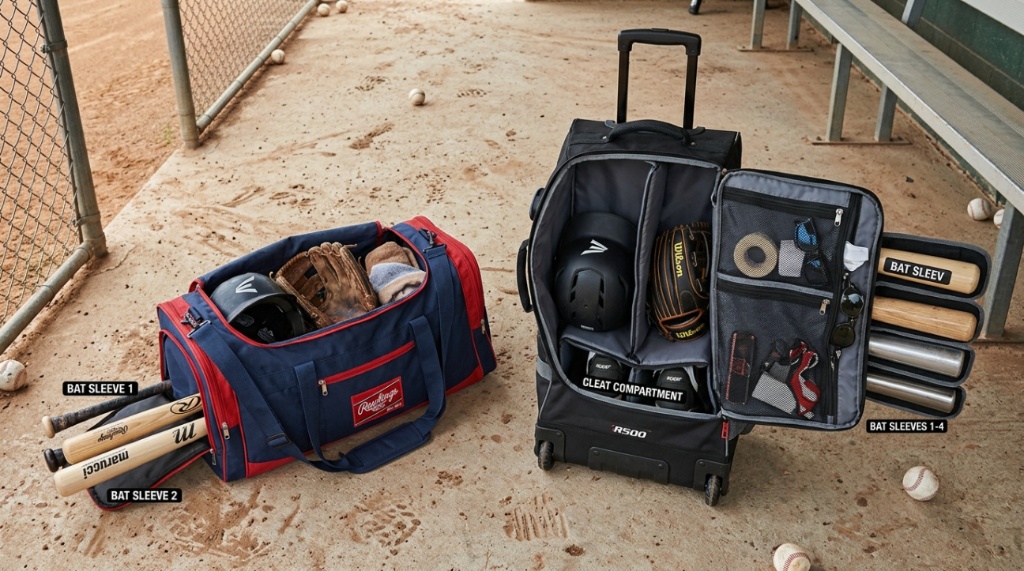
Wheeled bags typically offer more storage than backpacks, but the layout matters. Look for dedicated compartments for cleats, a separate pocket for dirty or wet items, and enough space for a helmet. Some bags have a molded compartment specifically designed to hold a batting helmet, which protects it from being crushed.
Consider how the bag opens. Full-length zippers that open like a suitcase make packing and accessing gear much easier than top-loading designs.
Comparing Wheeled Bags to Alternatives
To make an informed decision, compare wheeled bags against the other main options: traditional duffels and backpacks. Each has strengths and weaknesses that matter in different contexts.
| Feature | Wheeled Bag | Traditional Duffel | Backpack |
|---|---|---|---|
| Weight distribution | Excellent—weight rolls on the ground | Poor—all weight on one shoulder | Good—weight distributed across both shoulders |
| Best for terrain | Smooth, paved surfaces | Any terrain | Any terrain, especially uneven ground |
| Stairs and curbs | Difficult—must lift or drag | Easy—just carry it | Easy—just wear it |
| Storage when not in use | Bulky, doesn’t compress | Moderate—can flatten somewhat | Compact—easy to store |
| Weight of empty bag | Heaviest (8–12 lbs) | Medium (3–5 lbs) | Lightest (2–4 lbs) |
| Durability concerns | Wheels and handle can break | Zippers and straps wear out | Straps and seams can tear |
| Best user | Older players with heavy gear | Players with moderate gear | Younger players or light packers |
This comparison makes it clear that no single style is universally best. Your specific circumstances determine which bag will serve you well.
Common Mistakes to Avoid When Buying
Many players buy a wheeled bag and regret it because they overlooked simple details. Avoid these common pitfalls.
Buying Too Large
Bigger isn’t always better. A massive bag encourages you to pack more than you need, which makes the bag heavier and harder to maneuver. Choose a bag that fits your actual gear, not one that could hold everything you own.
Ignoring the Weight of the Empty Bag
Wheeled bags are heavy even when empty. A bag that weighs 10 pounds empty means you’re already carrying 10 pounds before you add any gear. If you ever need to lift the bag into a car trunk or carry it up stairs, that base weight matters.
Choosing Style Over Function
Team colors and logos are nice, but they don’t help when a wheel falls off mid-season. Prioritize construction quality, warranty, and replacement parts availability over aesthetics. A plain bag that lasts three seasons beats a flashy bag that falls apart in three months.
Forgetting About Storage at Home
Wheeled bags don’t fold flat. They take up significant floor space in a closet or garage. If you live in a small apartment or share storage space, this could be a real problem. Measure your storage area before buying.
How to Extend the Life of a Wheeled Bag
Once you own a wheeled bag, proper care keeps it functional for years. These maintenance tips are simple but often overlooked.
Clean the wheels regularly. Dirt and grass build up in the wheel housings, causing them to jam. A quick rinse with a hose and a wipe-down with a rag prevents most wheel issues.
Lubricate the telescoping handle occasionally with silicone spray. This keeps the handle extending and retracting smoothly. Avoid oil-based lubricants that attract dirt.
Don’t overload the bag beyond its rated capacity. Most wheeled bags are designed for 40–50 pounds. Exceeding that stresses the frame and wheels, leading to premature failure.
Store the bag indoors when possible. Extreme heat and cold degrade plastic components and rubber wheels. If you must store it in a garage or shed, keep it off the concrete floor and away from direct sunlight.
Frequently Asked Questions
At what age should a player switch to a wheeled baseball bag?
Most players transition to wheeled bags around 11–13 years old, when their gear load increases significantly. Younger players rarely carry enough equipment to justify the added weight and bulk of a wheeled bag. By middle school, catchers and players who carry extra gear benefit most from wheels.
Can wheeled baseball bags fit in standard lockers?
Generally, no. Wheeled bags are wider and taller than standard school or facility lockers. If locker storage is required, measure the locker dimensions first. Many players keep their wheeled bag in the dugout or car instead of a locker.
Are wheeled bags allowed on team buses?
It depends on the team and the bus. Some teams have strict cargo space limits and prefer soft-sided bags that compress. Others accommodate wheeled bags without issue. Check with your coach before purchasing if bus travel is common for your team.
How long do wheeled baseball bags typically last?
With proper care, a quality wheeled bag lasts 3–5 seasons. The wheels and handle are the first components to fail. Bags with replaceable wheels last longer than those with permanently attached wheels. Cheaper bags may only last one season under heavy use.
What is the weight limit for most wheeled baseball bags?
Most wheeled baseball bags are designed to handle 40–50 pounds of gear. Exceeding this limit stresses the frame, wheels, and handle. If your gear regularly exceeds 50 pounds, consider reducing what you carry or look for a heavy-duty model specifically rated for higher weights.
Conclusion
Deciding whether a wheeled baseball bag is worth it comes down to your specific situation. If you carry heavy gear, walk on paved surfaces, and deal with back or shoulder strain, a wheeled bag is a worthwhile investment that protects your body and makes game days easier. If you play on grass fields, travel by bus, or carry a light load, you’re better off with a traditional backpack or duffel.
Focus on wheel quality, handle design, frame construction, and storage capacity when shopping. Avoid oversized bags and prioritize durability over appearance. With the right choice, a wheeled bag can serve you well for multiple seasons and save your shoulders from unnecessary wear and tear. Take stock of your typical game-day routine, measure your storage space, and choose the bag that fits how you actually play.

You May Like