
Key Takeaways
- Perforated materials are versatile across industries.
- They improve energy efficiency and lighting in buildings.
- Panels help with sound absorption and acoustics.
- Used in automotive and industrial applications.
- Customizable patterns and materials.
- Many are recyclable and support sustainability.
- Modern technology improves production and consistency.
- Useful for both function and design.
Introduction
In today’s innovative design landscape, integrating functional and aesthetic solutions has become increasingly essential. Perforated materials play a crucial role by offering designers and engineers new ways to solve technical challenges while enhancing visual appeal. Their practical advantages, combined with artistic versatility, make them an attractive choice across a wide range of industries. Companies specializing in perforation processes help meet growing demands across different sectors in the United States. More about this can be found through reputable perforating companies whose work reflects these industry trends.
Whether in construction, manufacturing, or interior design, perforated materials bring robust benefits to product development. Their ability to balance utility and style not only improves performance but also transforms the appearance of buildings, vehicles, and everyday items.
Architectural Applications
The architectural industry has embraced perforated metals to create eye-catching facades and decorative elements. These materials can be adapted for various building components, offering both functional shading and artistic design. By strategically placing holes and patterns, architects manipulate natural light, reduce unwanted heat gain, and promote air circulation, thereby enhancing energy efficiency in modern buildings. According to Architectural Digest, this approach not only reduces energy consumption for heating and cooling but also brings a dynamic visual effect to building exteriors.
Lightweight and durable, perforated materials are an ideal choice for sun screens, privacy panels, and even stair railings. Their inherent versatility allows for creative texture experimentation, giving architects the flexibility to design unique, functional spaces that respond to environmental conditions without sacrificing style.
Acoustic Performance
Noise management remains a significant consideration in open workspaces, transportation hubs, and recreational venues. Perforated materials can absorb and scatter sound waves, reducing reverberation and creating quieter, more comfortable environments. In particular, perforated metal panels are known for their ability to improve acoustic quality in both public and private sectors. These panels are valuable additions to office ceilings, auditorium walls, and event spaces where sound clarity and comfort are priorities.
For an even deeper dive into specialized solutions, perforated acoustic panels represent a targeted application designed to optimize the acoustic environment of theaters, studios, and performance venues. This technology not only elevates the listening experience but also aligns with aesthetic preferences, giving interior designers more flexibility in creating harmonious spaces.
Industrial and Automotive Uses
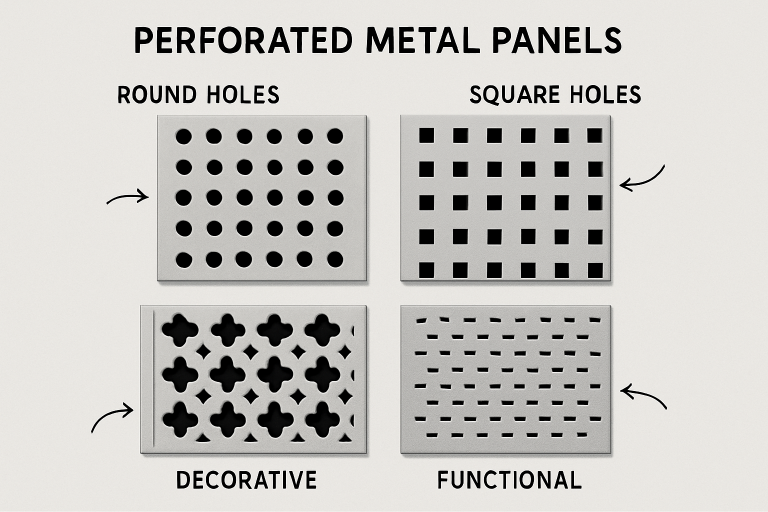
In industrial and automotive environments, the application of perforated materials extends far beyond surface aesthetics. Perforated sheets, used in filtration systems and machinery components, enable effective particle separation while maintaining structural integrity and airflow. Automotive manufacturers leverage these properties to develop lighter vehicle parts that do not compromise strength or durability. This approach supports the drive for greater fuel efficiency and higher overall vehicle performance.
Engineers can customize the size, shape, and pattern of perforations to meet exact technical specifications, such as increased ventilation, weight reduction, or enhanced cooling across a variety of systems and components. These technical advances contribute to safer, more reliable, and eco-friendly industrial practices.
Customization and Design Flexibility
One of the greatest advantages of using perforated materials lies in their adaptability to a wide range of design and performance requirements. Designers can select from numerous patterns, materials, and perforation densities to craft solutions tailored to each project. This flexibility results in products that are unique in appearance and precisely tuned to the environment where they will be installed.
For instance, interior designers often use perforated panels as partitions, creating semi-private spaces that do not block light. This creates open layouts while preserving a sense of separation, enhancing both utility and atmosphere. Such features make these materials a constant presence in forward-thinking commercial and residential design.
Sustainability and Environmental Impact
The use of perforated materials also supports sustainability initiatives in several ways. Many are manufactured from recyclable metals, reducing the demand for virgin resources and lowering the carbon footprint of construction and manufacturing projects. Additionally, perforation can help buildings optimize natural lighting and ventilation, which minimizes reliance on artificial lighting and mechanical air conditioning. This reduction in energy usage aligns with the shift toward green building practices recommended by the U.S. Green Building Council.
The long-lasting nature of these materials further limits the frequency and scope of replacements or repairs, keeping waste streams smaller and total lifecycle costs down. As environmental awareness becomes more central to design decisions, perforated materials are increasingly viewed as an effective tool for responsible construction and manufacturing.
Technological Advancements
Modern manufacturing technologies have dramatically improved the production of perforated materials. Digital modeling, precision lasers, and computer-controlled machinery enable the creation of intricate, high-quality designs at scale. Automation and real-time feedback systems also ensure consistency, reduce waste, and speed up turnaround times for custom orders. Industry 4.0 technologies, including artificial intelligence and IoT integration, are driving this transformation by enabling smarter monitoring and more efficient quality control, as Forbes reported.
These advancements mean that designers and engineers can pursue more complex patterns, faster prototyping, and enhanced consistency across large-scale projects, keeping pace with the demands of contemporary industry.
Final Thoughts
Perforated materials represent a compelling step forward in the interplay between innovation and tradition in modern design. From skyscrapers to concert halls, their blend of functionality, adaptability, and sustainability ensures that they remain an integral part of ongoing advancements in construction, manufacturing, and beyond. As technology continues to evolve, the potential for even more imaginative uses of these materials promises ongoing enhancements in both product performance and visual dynamics.

